- today
- label Guide
- favorite 0 likes

A Carhartt winter jacket can be both rugged workwear and a genuine streetwear staple. That's exactly the phenomenon behind this brand. Carhartt isn't a fashion company that one day decided to launch a collection inspired by workers' clothing. The history is actually the opposite: functional workwear came first, and only later did its distinctive look become a fully recognized streetwear style.
That's why the brand's iconic brown jacket with its small square logo looks just as good on a construction site or in a workshop as it does in the middle of a big city today. But the real question is: are Carhartt winter jackets actually a good choice? Which jacket should you pick for work, and which for everyday wear? And is the famous Duck Canvas really as tough as the brand's reputation suggests?
Carhartt for winter – in short
Yes, Carhartt can be an excellent choice for winter, but not every jacket from this brand is a true winter jacket. When choosing one, pay close attention to insulation, outer material, wind protection, and cut.
- For winter work: look for heavier models made from Duck fabric, Sherpa lining, well-designed cuffs, and an extended back.
- For the city: what matters most is the combination of comfort and a distinctive silhouette – this is where Detroit-style models really shine.
- For frequent commuting: a lighter insulated jacket may be more comfortable than a heavy Duck Canvas model.
- For work requiring a lot of freedom of movement: it's worth checking out models featuring Rugged Flex technology.
In my personal opinion, Carhartt winter jackets are quite heavy and stiff for everyday wear. There's no doubt they're extremely durable. However, I personally prefer a more sporty style, so it's a bit hard for me to find the perfect jacket model from this brand.
Carhartt – workwear first, streetwear style later
So how did it all actually begin? The brand's story starts in Detroit in 1889. That's when Hamilton Carhartt began producing clothing designed for people doing hard physical labor. One of the cornerstones of the company's growth was listening to workers themselves and designing products that met their real needs.
Over the following decades, Carhartt clothing became associated mainly with durability, heavy-duty fabrics, strong stitching, practical pockets, and cuts allowing freedom of movement. It was – and still is – workwear created above all for toughness.
Only later did these distinctive garments start making their way into urban culture. Simple cuts, natural colors, a small logo, and hardwearing materials fit perfectly into the streetwear style. Today, you'll find Carhartt products in both professional work outfits and everyday looks. Jackets are complemented by items like Carhartt pants, Carhartt hoodies, Carhartt t-shirts, and hats.
Carhartt vs. Carhartt Work In Progress – what's the difference?
This is a good place to clear up a common misunderstanding. Classic Carhartt and Carhartt Work In Progress, known as Carhartt WIP, are not exactly the same thing. Honestly? They're completely different product lines! Original Carhartt remains primarily a workwear brand. Many of its products are designed with work, durability, and functionality in mind.
Carhartt WIP, on the other hand, develops its own collections based on classic American Carhartt designs, reinterpreting them through the lens of fashion, skateboarding, music, and urban culture. If you're mainly interested in Carhartt jackets for work, start with the core Carhartt collection. If, however, your priority is urban Carhartt streetwear style, it's worth taking a closer look at the WIP collections as well.
Carhartt winter jacket – workwear or streetwear?
The most interesting part is that these two worlds don't have to be mutually exclusive at all. A well-chosen Carhartt winter jacket can serve you at work in the morning and look completely natural as part of an urban outfit just a few hours later.
| Feature | Work jacket | City jacket |
|---|---|---|
| Priority | Durability and functionality | Comfort and appearance |
| Outer material | Duck Canvas, heavy-duty work fabrics | Duck Canvas or lighter materials |
| Insulation | Matched to working conditions | Usually moderate |
| Pockets | High functionality | Ease of use is most important |
| Freedom of movement | Very important | Important, but not always crucial |
| Typical models | Bartlett, Sierra | Detroit, Gilliam |
That's exactly why Carhartt streetwear jackets look so authentic. Their style wasn't artificially designed to resemble workwear. These jackets were simply designed for work, and it just so happens they also look great on the street.
In my opinion, if your favorite everyday outfit is jeans, a shirt, and slightly looser-fitting clothes, you'll definitely appreciate Carhartt's winter jackets.
Duck Canvas – what exactly is it?
Duck Canvas, often simply called Duck, is one of the materials most strongly associated with Carhartt. It's a tightly woven fabric used in clothing that needs to hold up well under heavy use.
It's this outer material that gives many classic jackets their distinctive, rugged construction. In heavier models, Duck may initially feel much stiffer than fabrics used in typical city jackets.
Over time, the material breaks in alongside the wearer, develops more character, and often looks good even once natural signs of wear appear.
Based on our experience selling professional workwear, customers sometimes equate Duck Canvas itself with a winter jacket. That's not entirely accurate. What determines how warm a jacket will be is primarily the type of lining and insulation, not simply the thickness of the outer material.
Is Duck Canvas waterproof?
Classic Duck Canvas shouldn't automatically be treated as a fully waterproof material. Its main advantages are durability and toughness.
If a jacket is meant to be used regularly in rainy conditions, it's worth checking whether the specific model has an additional hydrophobic finish or a dedicated water-resistant technology. But let's be honest – when you're at work, you're usually not standing out in pouring rain. You can achieve limited water resistance by using spray or wash-in waterproofing treatments. It won't be 100% waterproof, but it provides a basic hydrophobic coating so the jacket doesn't soak through the moment it starts raining.
Rain Defender – helpful in light rain
Select Carhartt products feature a hydrophobic DWR finish, known as Rain Defender. Its job is to slow down how quickly water is absorbed by the fabric – droplets are meant to bead up on the surface and roll off more easily.
It's important, though, to distinguish a jacket with a hydrophobic finish from a technical rain jacket. Rain Defender makes clothing more versatile in changeable weather, light rain, or wet snow, but it shouldn't automatically be treated as a specialized membrane meant for hours of work in heavy rain.
Carhartt winter jackets – which models are worth knowing?
Carhartt winter jackets can differ significantly in construction. That's why, when buying one, you shouldn't rely solely on looks or the popularity of a particular name. Below are four models that clearly illustrate the brand's different approaches to outerwear.
Carhartt Detroit Jacket – a workwear legend and streetwear icon
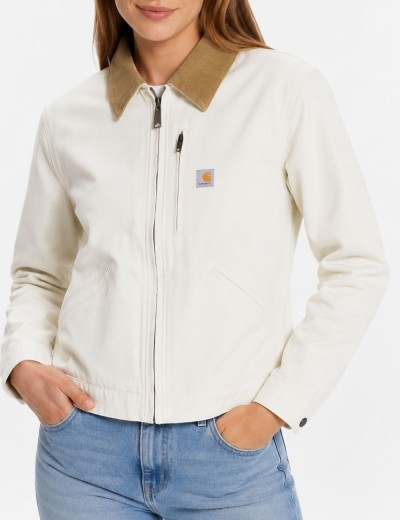
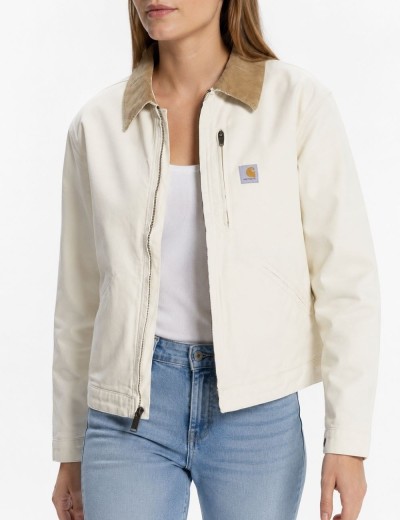
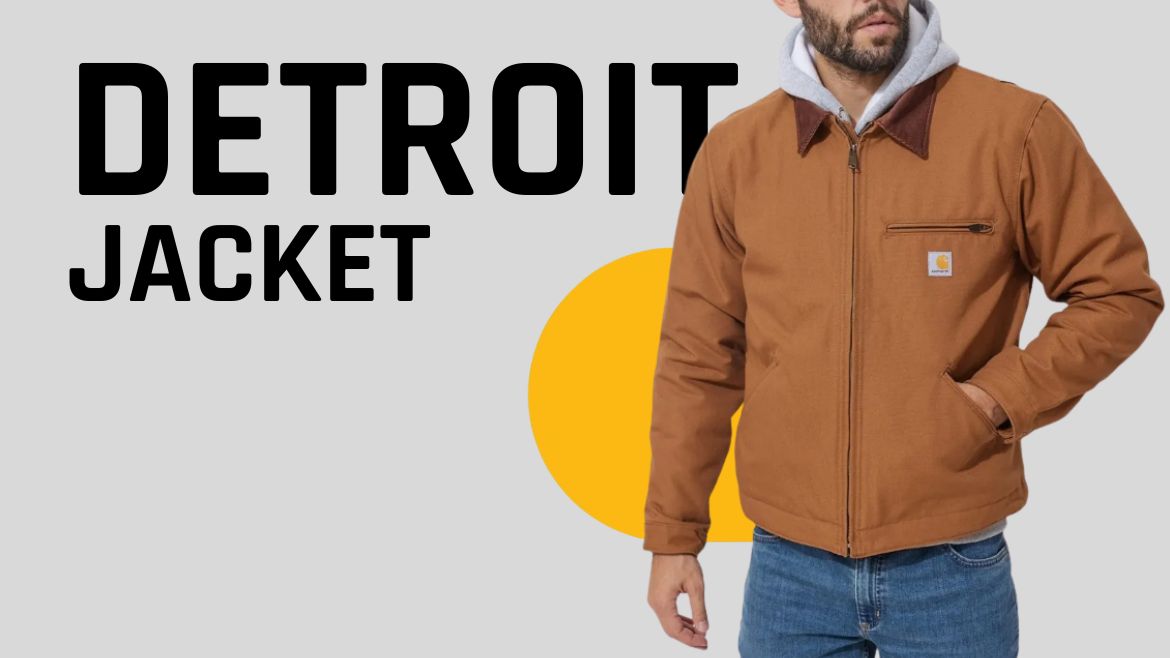
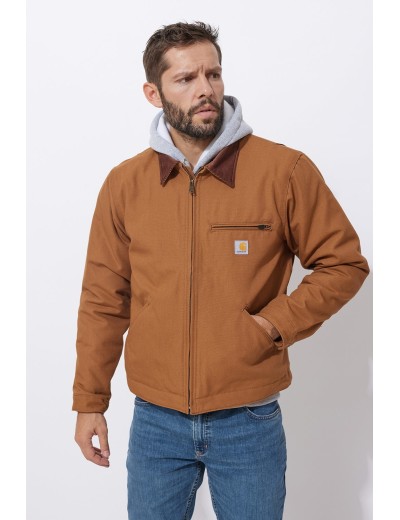
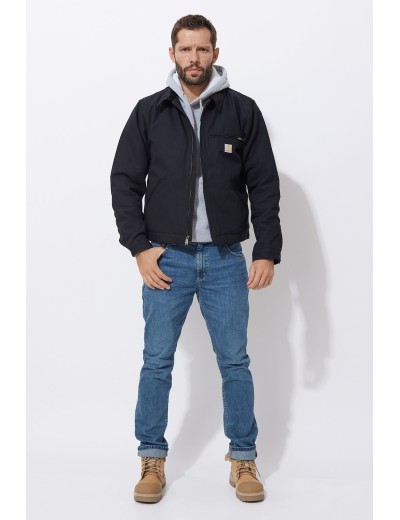
If one model had to symbolize Carhartt's transition from the world of work to the world of fashion, it would probably be the Carhartt Detroit Jacket. Its short cut, simple body, distinctive collar, and small logo created a design that works effortlessly in both worlds – on a construction site and in restaurants alike. The classic Detroit Jacket built its reputation as a durable, functional jacket. The modern Iconic J01 uses cotton Duck fabric, a blanket-lined body, and quilted lining in the sleeves.
If you're looking for a jacket specifically meant for winter, choose the Detroit model with the "lined" designation!
Bartlett Jacket – a tougher option for winter work
The Bartlett Jacket definitely leans more heavily into the brand's workwear roots. This model is made from heavy cotton Duck and features Sherpa insulation in the body and hood, while the sleeves use quilted lining. You'll also find features like triple-stitched main seams, an extended back, an adjustable hem, and both internal and external pockets.
If the main use is outdoor work, the Bartlett is a great example of what solid Carhartt work jackets should look like: the material, insulation, and details are all built around functionality.
Sierra Jacket – Duck, Sherpa, and classic workwear
The Sierra Jacket is another option for those looking for a classic American workwear look combined with insulation. The Carhartt Sierra Jacket uses heavy cotton Duck along with Sherpa lining. Its construction also includes internal cuffs to block out wind, an extended back, and triple-stitched main seams. It's a great example of what sets genuine Carhartt work jackets apart from jackets that only mimic workwear visually.
Gilliam Jacket – when you don't want a heavy Duck jacket
The Gilliam Jacket takes a completely different approach. Instead of heavy cotton, it offers a lightweight construction, synthetic insulation, a hydrophobic DWR finish, and Wind Fighter wind protection. It's an interesting choice for someone who spends a lot of time driving, moves between a warehouse and an office, or simply doesn't need a heavy Duck jacket all day long.
Carhartt quilted jackets like this one can be much more practical for everyday use than the heaviest work models.
Carhartt work jackets – what should you really pay attention to?
When choosing Carhartt work jackets, it's worth setting aside the product's looks for a moment and thinking about what actually happens to a jacket during a normal workday. Bending down. Lifting materials. Rubbing against surfaces. Getting in and out of a delivery van. Working with your arms raised. Contact with tools. Repeated washing.
That's why good Carhartt work jackets should above all offer:
- a durable outer material,
- strong stitching,
- adequate freedom of movement,
- functional pockets,
- well-designed cuffs,
- the right body length,
- insulation suited to working conditions.
This is exactly where material quality matters most. With professional clothing, durability often turns out to be more important than the number of extra features listed in the spec sheet.
Extra features that actually matter in winter
When it comes to a winter jacket, it's worth paying attention to a few elements that can have a real impact on comfort:
- internal cuffs – reduce cold air getting in through the sleeves,
- adjustable hood – important when working outdoors,
- extended back – provides extra coverage when bending over,
- internal pockets – help protect your phone or documents,
- adjustable hem – helps reduce drafts,
- stretch fabric – increases comfort during intense work,
- DWR – increases practicality in light rain and wet snow.
These extra features are usually what separates a jacket that looks great in photos from one that's still comfortable after eight hours of actual use.
Carhartt jackets for the city – does heavy-duty workwear make sense for everyday life?
Yes, but you don't always need the heaviest model. Carhartt jackets for the city are popular precisely because classic workwear pairs so well with simple everyday clothing. Jeans, a hoodie, sneakers, and a Detroit Jacket create an outfit that doesn't look like a construction-worker costume. At the same time, it's worth matching the construction to how you'll actually use it.
If you walk a lot and spend time outdoors, a heavier insulated Carhartt jacket can be an excellent choice. If, on the other hand, you spend most of your day in a car, on public transport, and in heated spaces, it's worth looking at lighter Carhartt jackets.
The same applies to other activities. Carhartt jackets for walking don't need the same parameters as clothing meant for a full day of outdoor work. For cycling, freedom of movement becomes more important, while for Carhartt outdoor jackets, it's best to choose models suited to specific weather conditions.
That said, Carhartt isn't a typical technical outdoor sportswear brand. If you need a jacket for intense mountain sports, an all-day ski trip, or long trekking in heavy rain, a specialized outdoor jacket may be a better tool for the job.
Which Carhartt jacket should you choose?
If you're wondering which Carhartt jacket to choose, start with how you'll use it, and only then consider the looks.
| Use case | What to look for | Suggested direction |
|---|---|---|
| Outdoor winter work | Sturdy material, good insulation, hood, cuffs | Bartlett / Sierra |
| City and streetwear | Distinctive cut and moderate weight | Detroit |
| Driving and frequent commuting | Low weight and freedom of movement | Gilliam |
| Intense work | Durability and flexibility | Rugged Flex models |
| Changeable weather | DWR / Rain Defender | Models with hydrophobic finish |
So instead of asking only "which jacket looks the best?", start with a simpler question:
Where will I be wearing it most of the time?
That answer usually narrows down your choice of Carhartt products to just a few genuinely sensible models very quickly.
How do you choose the right Carhartt size?
The best way to pick a Carhartt size is by checking the size chart for the specific product, rather than relying on the size you'd normally buy from other brands. Many jackets come in Relaxed Fit or Loose Fit cuts. These designs are intentionally built to leave extra room in the chest, shoulders, and body. In other words, it's often worth choosing a size smaller than you usually wear. Personally, I typically wear a size M or L in most brands, but with Carhartt I need to buy a size S – which is why my first few purchases ended up being returned.
What to wear with a Carhartt jacket?
For work, a natural companion to your jacket would be simple Carhartt t-shirts like the classic K87, and in winter you can round out the outfit with Carhartt hoodies and Carhartt winter hats.
It's precisely the simplicity of the designs that makes Carhartt jackets work with so many different styles. The same product can look completely different paired with work pants and heavy-duty boots than it does with classic jeans and sneakers.
Buying a Carhartt jacket – is it worth paying more?
If you're simply looking for the cheapest jacket to get through one season, buying a Carhartt jacket might not necessarily be the best solution. But if durability, functionality, and a design that doesn't go out of style after one season matter to you, there are far more arguments in its favor.
With many models, you're not just paying for the logo – you're paying for high-quality materials, strong stitching, practical pockets, proven cuts, and features that boost comfort on the job.
In our experience, this is exactly where it's worth looking at buying a jacket a bit differently than buying a typical seasonal wardrobe item. Well-fitted workwear is meant, above all, to keep performing well for a long time.
FAQ – frequently asked questions about Carhartt jackets
Is a Carhartt winter jacket good for winter?
Yes, as long as you choose a model with adequate insulation. Not every jacket from the brand is a winter model. When buying, check the type of lining, insulation, wind protection, and the design of the cuffs and hood.
Which Carhartt jacket should you choose for winter?
For outdoor work, it's worth starting with heavier models made from Duck fabric with insulation, such as the Bartlett or Sierra. For the city, the Detroit is an interesting choice, while those who prefer a lighter build may find the Gilliam more practical.
Is Duck Canvas good for winter?
Duck Canvas is above all a durable outer material. On its own, it doesn't determine how warm a jacket will be. Comfort in winter largely depends on the lining, insulation, and wind protection.
Are Carhartt jackets waterproof?
It depends on the specific model. You shouldn't assume that every jacket made from Duck is waterproof. Select products feature hydrophobic DWR finishes, which help in light rain but aren't the same as a specialized rain membrane.
How do you choose the right Carhartt size?
The best approach is to measure your chest circumference and compare it against the specific product's size chart. You should also pay attention to the cut – Relaxed Fit and Loose Fit styles are intentionally designed to leave more room than typical fitted city clothing.
Related products
Carhartt
Carhartt Acrylic Watch winter hat
Carhartt
Carhartt Detroit Duck Blanket-Lined jacket
Carhartt
Carhartt Duck Active winter jacket