- today
- perm_identity Igor z BalticBHP
- label Guide
- favorite 0 likes
Waterproof work boots are footwear that – according to the EN ISO 20345:2022 standard – has passed a whole-boot waterproofness test and carries the WR marking (usually within class S6 or S7). The problem is that in shops and on labels, the word "waterproof" is also used for boots that merely limit water absorption. In this guide, we explain what the symbols WPA and WR actually mean, how S3 differs from S7, and how to choose boots for working in rain, mud, or on wet floors.
Waterproof Work Boots – What Does It Mean?
In everyday store practice, four terms are used as if they were synonyms. The standard, however, distinguishes only two levels of water protection: a water-resistant upper (WPA) and a fully waterproof boot (WR).
| Term | What it means in practice | Standard designation | Suitable conditions |
|---|---|---|---|
| Hydrophobic | The upper material limits water absorption, but water can still enter through seams, the tongue, and joints | WPA (formerly WRU) | Dew, brief rain, wet grass |
| Water-repellent | A colloquial term – usually refers to a WPA upper, sometimes to a membrane | None | Depends on the model |
| Waterproof | The entire boot has passed a waterproofness test, including seams and the sole junction | WR (classes S6, S7) | All-day rain, mud, puddles |
| Watertight | A boot as sealed as a wellington – made of rubber or polymer, with no seams | S4 / S5 | Standing water, wash bays, agriculture, construction in water |
The key difference: WPA applies only to the upper material, while WR applies to the entire boot. That's why a boot made of hydrophobic leather can be labeled "waterproof" yet still get soaked after a few hours in the rain – water seeps in through the stitching and around the tongue.
WPA, WR, S6, and S7 Markings – How to Read the Label
Since the 2022 update to the EN ISO 20345 standard, full waterproofness has been built into two new protection classes: S6 (S2 + WR) and S7 (S3 + WR). The former WRU symbol has been replaced with WPA. Safety footwear placed on the market after March 30, 2023, is already certified under the new version of the standard, but in stores you'll still find models labeled the old way, e.g., "S3 WR".
| Symbol / class | What it guarantees | Are these waterproof boots? |
|---|---|---|
| WPA | The upper limits water penetration and absorption – the test lasts 60 minutes | No – these are hydrophobic boots, meaning they are not fully waterproof |
| WR | The entire boot does not let water through in a dynamic test (flexing the boot in water) | Yes |
| S2 | Toe cap + WPA upper | No |
| S3 | Like S2 + penetration-resistant insole and cleated sole | No (unless marked WR) |
| S3 WR (old standard) | S3 with full waterproofness | Yes – equivalent to S7 |
| S6 | S2 + WR | Yes |
| S7 (S7L, S7S) | S3 + WR; the letter L or S indicates the type of penetration-resistant insole | Yes |
| S4 / S5 | Rubber or polymer footwear (e.g., wellingtons) | Yes – watertight by nature |
Quick rule: looking for boots that truly won't let water in? The label must show WR, S6, S7, S4, or S5. "S3" or "WPA" alone only means protection against brief contact with water.
A membrane (e.g., GORE-TEX) is not itself a standard designation – it's a technology that usually allows the manufacturer to achieve WR. So check the symbol, not just the membrane's brand name.
For more on the other symbols (SB, S1, S1P, SRC, ESD), read the article S1 Work Boots – What Does It Mean? Classification of Work Boots.
Are S3 Boots Waterproof?
Not fully. Class S3 only requires a WPA upper, meaning a material that doesn't let in or excessively absorb water for about an hour. For rainy autumn weather, working in mud, or at a wash bay, choose S3 marked WR or class S7.
In practice, well-impregnated leather S3 boots can handle a passing shower. During all-day outdoor work, water will eventually get in through the seams. You'll find a full list of models in this class in the S3 work boots category.
Membrane or Leather – What Provides Waterproofness?
Full waterproofness in work boots is achieved in two ways: with a membrane sewn under the upper, or through a seamless construction (rubber, polyurethane). Leather alone, even when impregnated, usually only reaches WPA level.
- Membrane (e.g., GORE-TEX) – blocks water from outside while letting water vapor escape from the foot. The best choice if you're on your feet all day and don't want sweaty, damp feet.
- Hydrophobic leather – durable, shapes well, easy to refresh with impregnation spray. Sufficient for brief contact with water.
- Rubber / PU (S4, S5 wellingtons) – completely sealed but not breathable. For standing water and washing.
We've covered a detailed comparison of both solutions in the guide Leather Boots or Boots with a Membrane?
Which Waterproof Boots for Which Job?
Match the level of protection to how long and how intensively your feet will be in contact with water. Over-specifying also has a cost: boots with a membrane are heavier, more expensive, and less breathable in a dry warehouse.
| Working conditions | Contact with water | Recommended class | What else to check |
|---|---|---|---|
| Warehouse, hall, workshop | Occasional (spilled water) | S1P or S3 | Slip-resistant sole (SR) |
| Construction site in spring/summer | Brief rain, wet grass | S3 (WPA) | Leather impregnation |
| Construction site in autumn/winter | Rain, mud, snow all day | S7 / S3 WR | High shaft, insulation (CI) |
| Road building, gardening, earthworks | Puddles, wet ground | S7 / S3 WR | Deep tread, ankle protection |
| Drivers, couriers | Getting out in the rain | S3 WR or S7, low-cut model | Lightness, comfort while driving |
| Wash bays, agriculture, sewage plants | Standing water, chemicals | S5 (wellingtons) | Resistance to chemicals and oils |
If you work in low temperatures, combine waterproofness with insulation – see our winter work boots. For standing water, work wellingtons are a good option.
What to Look for When Buying – A Checklist
- Symbol on the label – WR, S6, S7 (or S3 WR) means full waterproofness; S3 or WPA alone does not.
- Membrane – if you're active and moving all day, choose a model with a breathable membrane.
- "Bellows" tongue – a tongue sewn to the upper along its full height keeps water out from the top.
- Shaft height – ankle-high boots protect better in puddles than low-cut shoes.
- Sole – deep tread and the SR marking for wet, slippery surfaces.
- Insulation – for winter, look for the CI symbol (cold insulation).
- Size with thick socks – in autumn and winter, try on boots with the socks you'll actually wear at work.
At the Baltic BHP store, you can find fully waterproof footwear using the Waterproofness → "Waterproof – certified and fully waterproof" filter in the work boots category. The "Hydrophobic" option refers to boots with limited water absorption.
How to Care for Waterproof Work Boots
Waterproofness weakens when mud, cement, and road salt clog the pores of the leather and membrane. Regular cleaning and impregnation can extend the protection's effectiveness by several seasons.
- After work, remove mud with a soft brush and a damp cloth.
- Remove the insole and let the boots dry at room temperature – never on a radiator or near a heater, as this cracks the leather and weakens the sole's adhesive.
- Every few weeks, apply an impregnating agent suited to the material: a different one for smooth leather, another for nubuck, and another for membrane fabric.
- For boots with a membrane, avoid oily waxes over the entire upper – they can reduce breathability.
FAQ – Frequently Asked Questions
What does WR mean on work boots?
WR (water resistance) is a test-confirmed waterproofness of the entire boot, including the seams and sole junction. Since 2022, it has been part of classes S6 and S7.
What's the difference between WPA and WR?
WPA applies only to the upper material and its resistance to water for about 60 minutes. WR covers the entire boot and means water does not get inside.
Are waterproof and watertight work boots the same thing?
Colloquially, yes, but "watertight" usually refers to rubber or polymer footwear (S4, S5) with no seams. Waterproof leather or textile boots achieve WR thanks to a membrane.
Is S7 better than S3?
S7 has all the features of S3 plus full waterproofness. It's not necessary in a dry warehouse and can be heavier and less breathable.
Do membrane boots make your feet sweat?
A membrane lets water vapor escape, so feet sweat less than in rubber boots. Moisture-wicking socks help too.
Will impregnation turn S3 boots into waterproof boots?
Impregnation improves the leather's water resistance, but it won't seal the seams. It also doesn't change the protection class – the boot will remain S3, not S7.
Related products
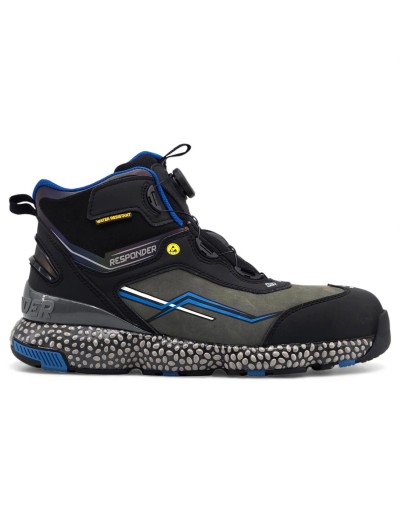
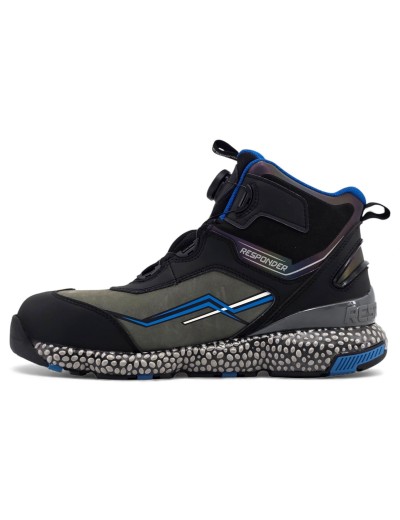
Sir Safety
Sir Safety Manhattan S7S Work Shoes